
Lessons stop. Your students don’t stop needing you. Here’s how to stay in the picture when the calendar says break.
Every teacher and coach has an off-season. For a tutor, it’s summer. For a tennis or swim coach, it’s the months when the courts are empty or the pool is closed. For a music teacher, it’s the weeks when families travel. For a coach on tour, it’s whenever you’re away.
Those breaks usually mean two things at once: your income dips, and your students lose ground. Then you spend the first weeks back rebuilding what they forgot.
Going online doesn’t have to replace a single in-person lesson. It can fill the gap. A short course built for the break keeps students practicing, keeps families connected to you, and gives you something to sell while you’re not on the court or in the classroom. This post covers what to sell, how to package it on ClassSync, and when to build it so it’s ready before the break starts.
What the break costs your students
If you teach an academic subject, you’ve seen the summer slide. Research puts numbers on it.
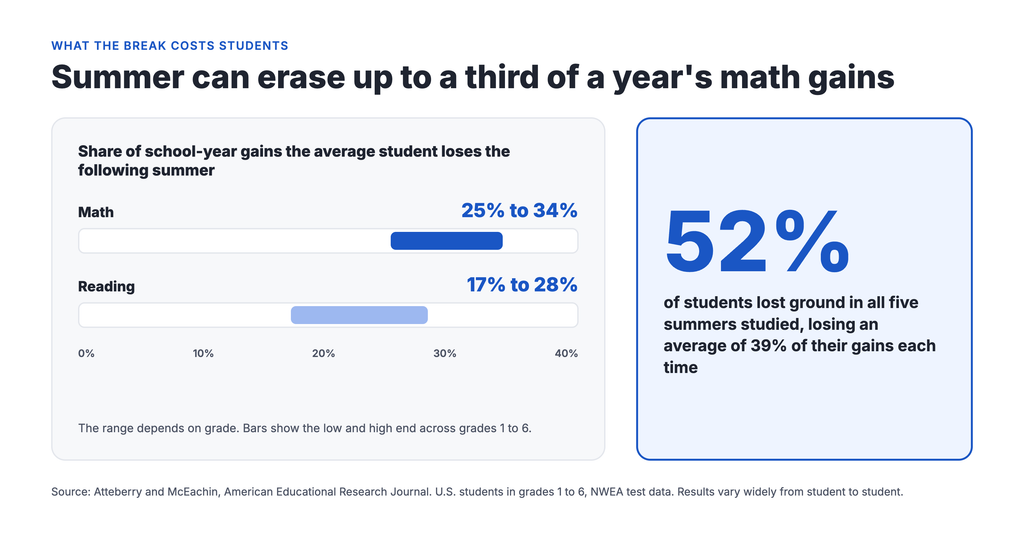
A large national study published in the American Educational Research Journal followed U.S. students across five summers between grades 1 and 6, using test data from NWEA. It found that:
- In math, the average student lost 25% to 34% of each school year’s gains the following summer, depending on grade.
- In reading, the average student lost 17% to 28%.
- 52% of students lost ground in all five summers, losing an average of 39% of their school-year gains each time.
The researchers also stressed that students vary a lot. Some keep learning over the summer, while others lose almost everything they gained. That gap is where a short summer course can help.
The study covered elementary grades, so older students may look different. And we’re not aware of comparable data for sports or music skills. Still, many coaches will recognize the pattern of a student coming back rusty after a long break.
What it costs you: for most private teachers and coaches, a break means fewer paid sessions. And when students come back behind, the first weeks of the new season go to catching up instead of moving forward.
What to sell in the off-season
The best off-season course solves the problem the break creates. Keep it short and focused: one goal, a few weeks of lessons.
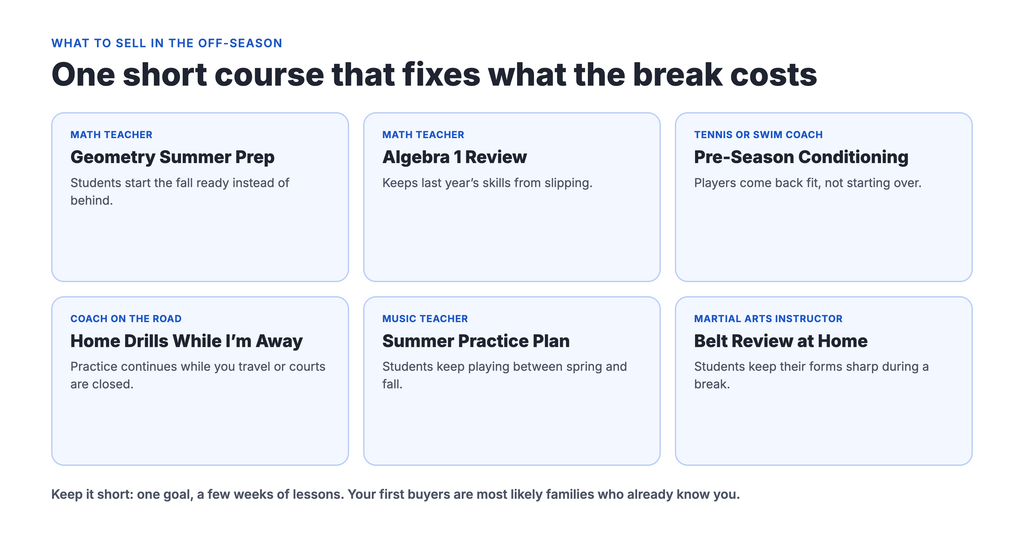
| If you teach | Off-season course idea | What it solves |
|---|---|---|
| Math or another school subject | Geometry Summer Prep | Students start the fall ready instead of behind |
| Math or another school subject | Algebra 1 Review | Keeps last year’s skills from slipping |
| Tennis, swim or another sport | Pre-Season Conditioning | Players come back fit, not starting over |
| Tennis, swim or another sport | Home Drills While I’m Away | Practice continues while you travel or the courts are closed |
| Music | Summer Practice Plan | Students keep playing between spring and fall |
| Martial arts | Belt Review at Home | Students keep their forms sharp during a break |
Two things make these easier to sell:
- They have a clear finish line. “Be ready for Geometry in September” is easier to say yes to than “keep learning.”
- They’re for students who already trust you. Your current families are your first and most likely buyers, so you don’t need a big audience to start.
You can also reach new students. A family that moved away, a player who trains in another city, or a parent who found you online can buy the same course.
How to package it on ClassSync
On ClassSync, the course is what students buy, and lessons live inside it. You can sell a course on its own, group several into a course bundle, or offer ongoing access through a membership or a bundle membership.
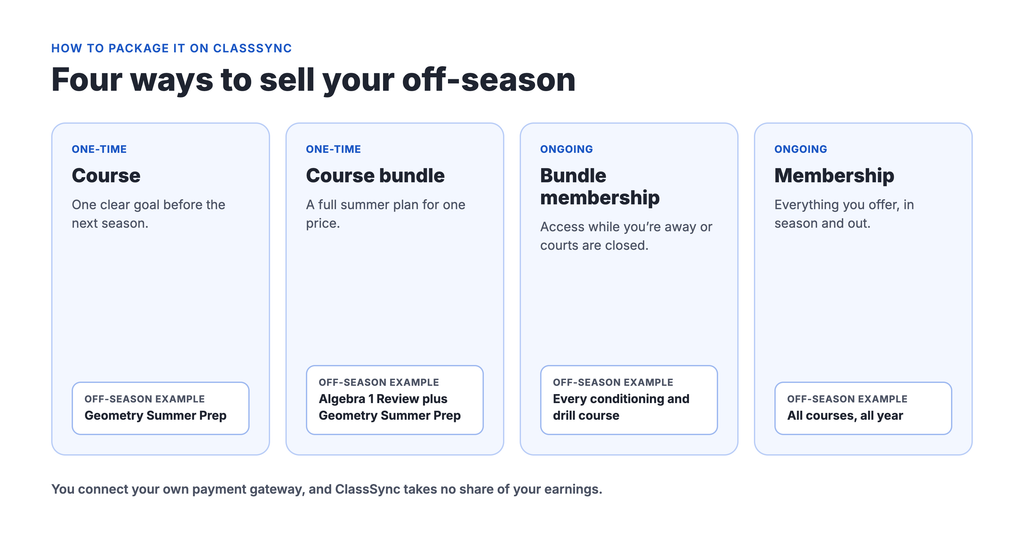
For the off-season, that gives you a few options:
| Offer | Off-season example | Good for |
|---|---|---|
| Course | Geometry Summer Prep | One clear goal before the next season |
| Course bundle | Summer Bundle: Algebra 1 Review plus Geometry Summer Prep | Families who want a full summer plan for one price |
| Bundle membership | Off-Season Training: every conditioning and drill course | Ongoing access while you’re away or the courts are closed |
| Membership | All courses, all year | Families who want everything you offer, in season and out |
Where to put it: keep it in the structure you already use. A math teacher could place Geometry Summer Prep under the Sophomore category and the Geometry sub-category, where incoming sophomores will look. A coach could add it under the level it’s for, like Intermediate.
A few things that make this easier on ClassSync:
- You set it up yourself. Templates and live editing, with no coding or design skills needed.
- You keep your earnings. You connect your own payment gateway, and ClassSync takes no share. You pay only your processor’s standard fee.
- Students watch anywhere. Phone, tablet, laptop, desktop or smart TV, so a student on vacation can still keep up.
ClassSync’s Launch Pad plan includes 3 courses, which is enough for one or two off-season courses next to what you already offer. Larger plans include more.
When to build it
The off-season is a hard time to start building, because by then your students have scattered. Build it during the season, while you’re still seeing students every week. Here’s a simple schedule to adjust to your own pace:
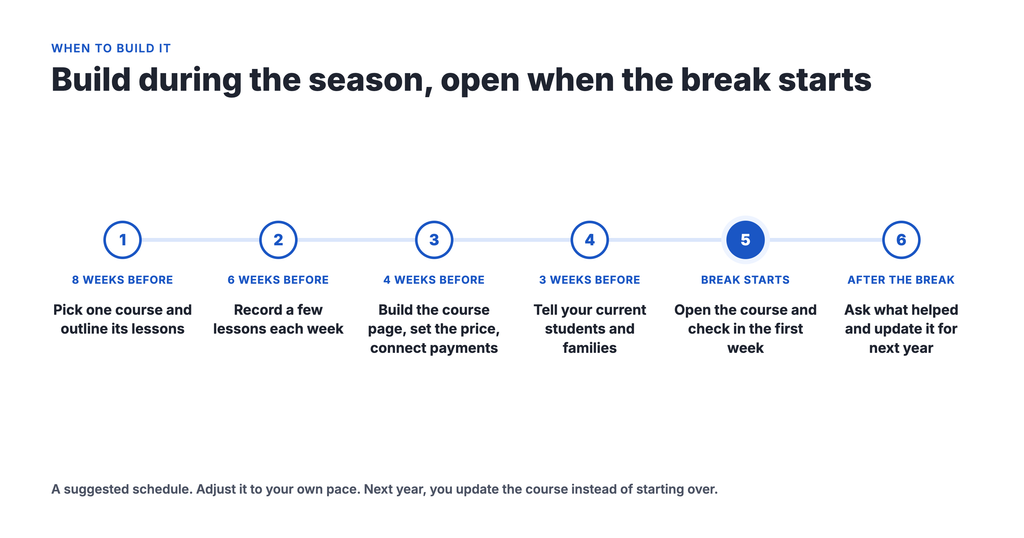
| When | What to do |
|---|---|
| About 8 weeks before the break | Pick one course and outline its lessons |
| About 6 weeks before | Record a few lessons each week |
| About 4 weeks before | Build the course page, set the price, connect payments |
| About 3 weeks before | Tell your current students and families, in person and by email |
| When the break starts | Open the course and check in with students in the first week |
| After the break | Ask students what helped, and update the course for next year |
The last row is the one that pays off over time. A course you build once can come back every off-season with a few updates, instead of being rebuilt from scratch.
The honest part: what to expect
We’d rather you go in with the right expectations than be disappointed.
- It’s not instant income. Building a good course takes real hours, and your first off-season sales will probably be modest. Most of them will likely come from families who already know you.
- It’s not fully passive, either. Students still need a nudge, a check-in or a question answered now and then.
- It gets easier the second time. The first course is the most work. After that you’re updating, not starting over.
- If you teach at a school, check who owns your materials. Documents you made for your job may belong to your district, so build fresh materials for your course on your own time. We cover this in 71% of Teachers Have a Side Job (general information, not legal advice).
What an off-season course does well is give you a way to keep teaching when the calendar says stop, and give your students a reason not to start the next season behind.
Frequently asked questions
How can teachers earn money over the summer?
One option is a short online course for the summer break, like a review or a prep course for the next grade. You build it during the school year and sell it to current families and new students before the break starts.
How much do students lose over the summer?
In a large national study of students in grades 1 to 6, the average student lost 25% to 34% of a school year’s math gains and 17% to 28% of reading gains the following summer. Results vary widely from student to student.
What can a coach sell in the off-season?
Short courses that keep players training while lessons are paused: pre-season conditioning, home drills, or technique work for one skill.
How do I sell an off-season course on ClassSync?
Create it as a course, then sell it on its own, group it with others in a course bundle, or include it in a membership or bundle membership. You connect your own payment gateway, and ClassSync takes no share of your earnings.
When should I start building it?
During the season, about two months before the break, while you’re still seeing students every week.
Plan your off-season course this week
Think about your next break. What do your students lose by the time they come back? Write that down, and you’ve found your first off-season course.
See how a full program looks in our demo academies, Ryman Arts and Ivy Mathematics. When you’re ready, choose a plan and build it before the break.