
Which online course platform fits a music school, tutoring center or studio? An honest look at pricing, fees and structure, updated October 2026.
Most platform comparisons are written for a solo creator selling one course. If you run a school, your needs are different. You might have piano, guitar and voice, each with beginner to advanced levels. That’s nine courses before you’ve added a single summer camp. You have more than one teacher. And you have families who expect a clear path from level to level.
That changes which platform makes sense. A plan that looks cheap can get expensive fast if it caps your course count or charges per student.
We compared four platforms through that lens: Kajabi, Teachable, Uscreen and ClassSync. Full disclosure: we make ClassSync, so we have a point of view. To keep it fair, every competitor figure below comes from their published pricing as of October 2026, and we link our sources at the end.
ClassSync vs Kajabi vs Teachable vs Uscreen at a glance
The short version: for a school that needs its own branding and a team of teachers, ClassSync’s Professional plan costs $129.99 a month. The comparable plans on Kajabi, Teachable and Uscreen cost $189 to $249 a month, and Uscreen adds a fee for every student.
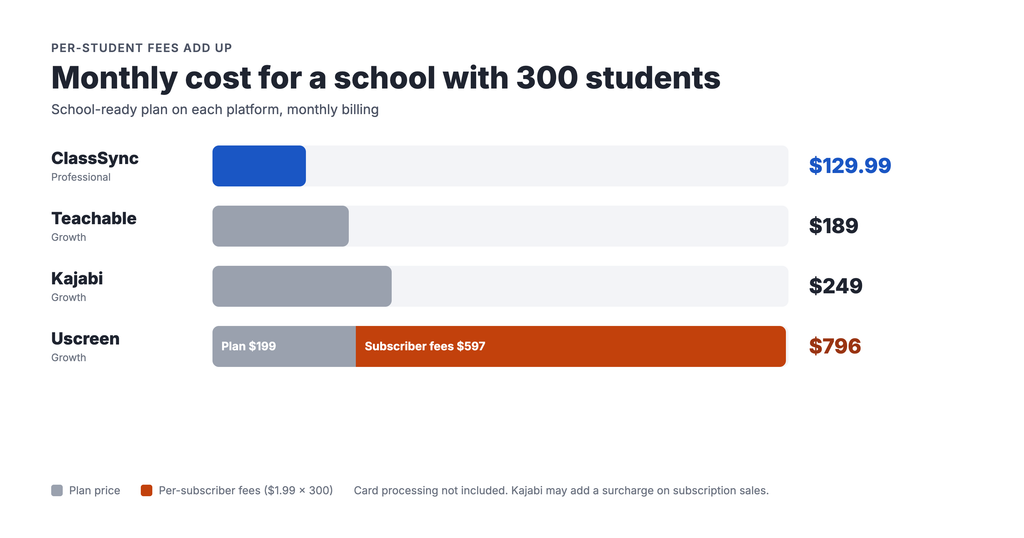
We compare each platform’s school-ready plan: the lowest plan that gives you your own branding, several admin seats and room for multiple programs. Entry plans are listed at the bottom. All prices are monthly billing.
| ClassSync | Kajabi | Teachable | Uscreen | |
|---|---|---|---|---|
| Best for | Schools and academies with several programs and levels | Creators selling courses and coaching, with built-in marketing | Creators selling individual courses | Video membership and streaming businesses |
| School-ready plan | Professional: $129.99/mo | Growth: $249/mo | Growth: $189/mo | Growth: $199/mo + $1.99 per subscriber |
| Monthly cost with 300 students | $129.99 | $249* | $189 | $796 |
| Platform fee on your sales | 0%, and you can use your own payment gateway | 0% with Kajabi Payments* | 0% | 5% on one-time sales |
| Courses on that plan | 18 courses, organized by category, sub-category, course and lesson | 50 products | 50 products | Unlimited |
| Admin seats on that plan | 6 | 10 | Multiple, with custom permissions | Not listed |
| Your own branding | Custom domain included | Branding removal included | White-label site included | Custom domain included |
| Setup | Do it yourself: page builder with live editing, no coding or design skills | Kajabi runs a marketplace of paid setup experts | Do it yourself | Do it yourself; migration help on $449+ plans |
| Entry plan | Launch Pad: $29.99/mo (3 courses, 1 admin) | Basic: $179/mo (5 products, 1 admin) | Starter: $39/mo (5 products, 100 students, 7.5% fee on sales) | Starter: $49/mo (100 subscribers, 10% fee on one-time sales) |
*Since January 2026, reviewers report Kajabi adds a surcharge on subscription and payment-plan sales made through Kajabi Payments. Check Kajabi’s pricing page for current terms.
Why we compare the higher plans. Entry plans look cheap, but most can’t run a real school. Kajabi Basic allows five products, one admin and doesn’t remove Kajabi branding. Teachable Starter takes 7.5% of every sale and caps you at 100 students. Uscreen Starter caps you at 100 subscribers on a Uscreen-branded web address. On each platform, a school with several teachers and its own brand ends up on the Growth plan.
The hidden cost: who sets it up?
The monthly price is only part of the bill. The other part is how long it takes to get running, and whether you can do it yourself.
Kajabi does a lot, and doing a lot takes setup. Sales funnels, pipelines, email automations, landing pages, payment settings and membership access all need to be configured. That’s why Kajabi runs its own marketplace of experts you can hire, and why freelance sites are full of “Kajabi setup” gigs. A typical job post asks a freelancer to handle branding, product pages, landing pages, funnels, payment gateways and email sequences from scratch. For a creator building a marketing machine, that power is worth it. For a piano school that just wants its lessons online, it’s a lot of machinery to pay for and manage.
ClassSync is built so you never need an agency. Here’s what getting started looks like:
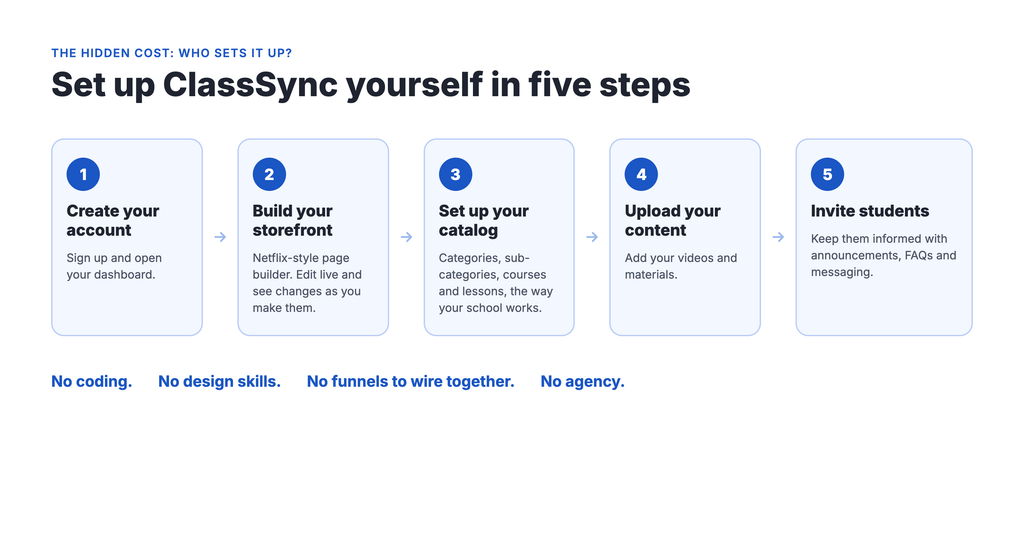
- Create your account.
- Build your storefront with the Netflix-style page builder. You edit live and see changes as you make them.
- Set up your catalog the way your school already works: categories, sub-categories, courses and lessons.
- Upload your videos and materials.
- Invite students and keep them informed with built-in announcements, FAQs and messaging.
No coding. No design skills. No funnels to wire together. We tested setup with more than 10 people who had no tech background before we called it ready, because we built it for school owners, not tech teams.
Which platform fits which school
Each of these platforms is good at something. Here’s an honest read on who each one suits.
Kajabi: best for marketers who want everything in one place
Kajabi bundles courses, email marketing, sales funnels and communities. If you’re building a personal brand around heavy marketing, that bundle is the appeal.
For a school, the catch is cost. Kajabi raised prices and removed its cheapest public plan in January 2026. Basic, at $179 a month, allows five products and one admin, and keeps Kajabi branding. Affiliates, advanced automations and branding removal start on Growth, at $249 a month.
Teachable: best for creators launching a course
Teachable is simple to start and says its mobile app is included on every plan. It also handles sales tax and VAT through its own payments.
The tradeoffs: Starter, at $39 a month, takes 7.5% of every sale and caps you at 100 students. A fully white-labeled school with multiple admins starts on Growth, at $189 a month. Teachable is built around selling courses as separate products rather than organizing a school catalog.
Uscreen: best for video streaming and TV apps
If your business is a video library people subscribe to, like a yoga or fitness channel, Uscreen is strong. It offers a Netflix-style catalog, live streaming, and branded mobile and TV apps.
The tradeoffs for schools: Growth costs $199 a month plus $1.99 for every subscriber, every month. At 300 students, that’s $796 a month, and the bill keeps climbing as you enroll more. Branded mobile apps start at $449 a month plus $0.99 per subscriber.
ClassSync: best for schools with multiple programs
ClassSync is built for academy operators: music schools, tutoring centers, language schools and martial arts studios. Your online academy is organized the way your school already is. You pay one flat monthly price with no fee per student and no cut of your sales, and you can set it up yourself.
Why schools choose ClassSync
You can set it up yourself, today. No agency, no freelancer, no funnels to wire up. Pick a template, add your own images and videos, and edit the page live so you see exactly what students will see. No coding or design skills needed.
It’s organized like a school, not a store. Kajabi and Teachable count every course as a separate product. ClassSync organizes your academy into categories, sub-categories, courses and lessons. Piano becomes a category. Beginner and Advanced become sub-categories. Each unit is a course with its own lessons. Students see a clear path from level to level, and you manage one catalog instead of a pile of products.
One flat price, no matter how many students enroll. There’s no per-student fee, so your bill doesn’t grow every time a new family signs up. At 300 students, ClassSync Professional costs $129.99 a month. Uscreen Growth costs $796.
You keep 100% of your tuition. ClassSync takes no share of your sales, and you can connect your own payment gateway. Only your card processor’s standard fee applies.
Room for your whole team. Professional includes six admin seats and a custom domain, and you can assign instructors to their own courses, all under your school’s name.
More ways to earn. Sell single lessons, full courses or memberships. You can also run an affiliate program, host ads, or form partnerships.
Students learn on any device. Phone, tablet, laptop, desktop or smart TV.
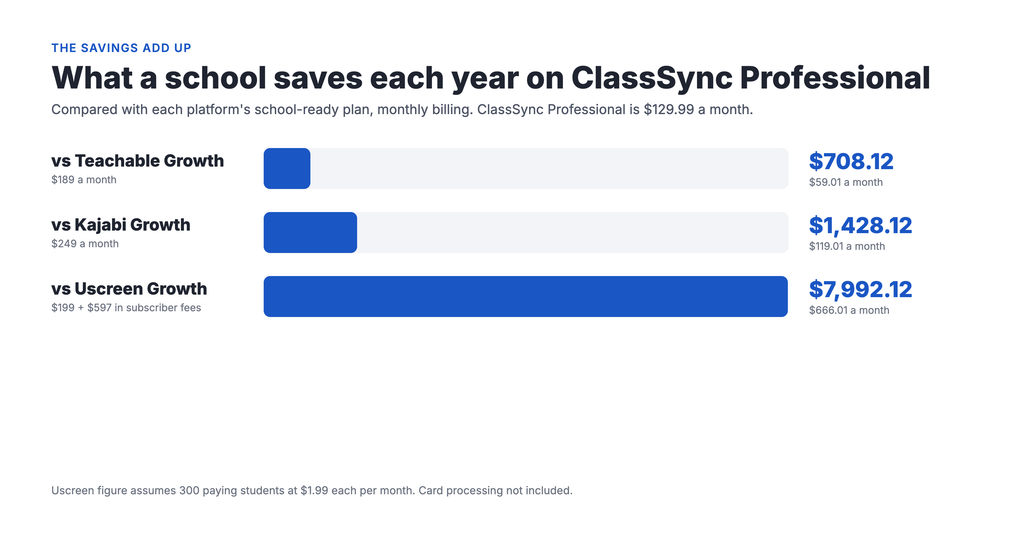
The savings add up. Compared with each platform’s school-ready plan at monthly prices:
| Compared with | Their monthly cost | You save each month | You save each year |
|---|---|---|---|
| Kajabi Growth | $249 | $119.01 | $1,428.12 |
| Teachable Growth | $189 | $59.01 | $708.12 |
| Uscreen Growth, 300 students | $796 | $666.01 | $7,992.12 |
See it for yourself. Two live demo schools show what a finished academy looks like: Ryman Arts and Ivy Mathematics.
Frequently asked questions
What’s the most affordable platform for an online academy?
For a school that needs its own branding and several admins, ClassSync Professional is the lowest at $129.99 a month. The comparable plans are Teachable Growth at $189, Uscreen Growth at $199 plus $1.99 per subscriber, and Kajabi Growth at $249.
Do I need to hire someone to set up Kajabi?
Not necessarily. But Kajabi has many moving parts, from funnels to email automations, and enough people want help that Kajabi runs its own marketplace of experts for hire. ClassSync is designed so school owners can set everything up themselves.
Is Kajabi’s $179 Basic plan enough for a school?
Usually not. Basic allows five products and one admin, and it doesn’t remove Kajabi branding. Affiliates, advanced automations and branding removal start on the $249 Growth plan.
Does Uscreen charge per student?
Yes. On its Growth plan, Uscreen charges $1.99 per subscriber each month on top of the plan price. At 300 students, that’s $796 a month on monthly billing.
Can I start small with ClassSync?
Yes. Launch Pad costs $29.99 a month with three courses and 20 hours of video storage. When you’re ready for your own domain and your teaching team, move up to Professional.
See how your school would look on ClassSync
Browse our demo academies, Ryman Arts and Ivy Mathematics, or see plans and get started. You can have your catalog set up without hiring anyone.